










I vote FOR

Together, let’s restore meaning to every vote !

The I Vote For It campaign invites you to become the driving force behind this change. You don’t need to be a political expert to make a difference: your voice and your network are your greatest strengths.
  • Showcase your commitment online : Use our exclusive graphic assets to spruce up your social media profiles (Facebook, X, Instagram), personalize your email signature, or add some flair to your online interactions. Let those around you know that democracy matters to you.
  • Raise awareness among those close to you : Share this campaign with those around you. It is through word of mouth and digital sharing that our message will become essential.

Voting is the power of the people. Let’s make it truly count.

Support our citizen movement : 4 concrete actions

  • Become a member : Officially join our engaged citizen community and take an active part in the movement’s decision-making.Officially join our engaged citizen community and take an active part in the movement’s decision-making.Become a member
  • Subscribe to the newsletter : Stay informed about the latest news, available tools, and upcoming mobilizations so you don’t miss a thing.   Subscrive   
  • Make a donation : Support the “I Vote For” campaign. Every financial contribution gives us the means to amplify our message, produce advocacy materials, and reach an even wider audience.     Make a donation       
  • Subscribe to our Facebook page and our Instagram for ongoing content.            Facebook            
I vote FOR

to reform an unfair electoral system

Jean-Pierre Charbonneau, president of the Mouvement démocratie nouvelle, outlines the democratic benefits of reforming the electoral system for the governance of Quebec.
I vote FOR

a mixed proportional electoral system with regional lists

The electoral system currently used in Quebec—single-member plurality voting—served its purpose well when there were only two parties running in elections. That reality, however, is now a thing of the past. Today, Quebec voters have a much broader range of political choices. While this diversity is enriching, it also highlights the limitations of the existing system, which creates significant inequalities in representation and in the formation of government. It has therefore become necessary to adopt an electoral system that truly reflects the will of the people and strengthens the democratic quality of our institutions—a system where every vote counts, where every political perspective is fairly represented, and where every region has a voice that is both just and proportionate. This is what a mixed-member proportional system with regional lists offers.

The proposed system was developed through a cross-party process, following an extensive tour of Quebec’s various regions.

Projet de Loi 199 :

Bill 199, titled “An Act to Establish a New Electoral System”—introduced in November 2025 by a member of the National Assembly from Québec solidaire, with the support of the Parti Québécois and the Conservative Party of Quebec—proposes a mixed-member proportional electoral system with regional compensation. Such a mixed system combines two voting methods: some members would continue to be elected in local constituencies, while compensatory seats would be allocated in each region based on lists of candidates. This is intended to ensure that each party’s political weight more accurately reflects the popular vote, both within each region and across the entire territory of Quebec.

Quebec would be divided into 80 local constituencies—similar to those that currently exist—with members elected to represent each one according to the current electoral system.

The territory would also be divided into 17 regions, corresponding to Quebec’s existing administrative regions. In each region, compensatory seats would be assigned to candidates appearing on lists submitted by political parties that have secured at least 4% of the vote at the provincial level. There would be a total of 49 such “regional” seats.

Consequently, the total number of seats in the National Assembly would increase from 125 to 129.

Each voter would receive two ballots: the first to select a member for their local constituency, as is currently the case; and a second to designate a political party of their choice. This second ballot would be tallied at the regional level to determine the regional members.

The allocation of regional seats within an administrative region would be designed to compensate for the outcomes of the local constituency elections within that same region. Indeed, under the current electoral system, it is not uncommon for a single political party to sweep an entire region, even when other political parties have secured a significant number of votes. Regional seats would therefore be allocated in a way that ensures the overall distribution of seats within a region better reflects the political diversity of all votes cast across that region.

Whether elected through a local constituency vote or via a political party’s regional list, all members of the legislature will enjoy the same rights, privileges, and immunities. In short, while a constituency-based member will continue to represent the citizens of their specific riding, regional members will also serve as representatives for all citizens throughout that region. We believe that citizens stand to benefit most from this new arrangement, as it will provide them with access to a more diverse range of support from their elected representatives. Furthermore, this new dynamic will inevitably encourage all members within a region to work together in the region’s best interests, regardless of their political affiliation.

I vote FOR

every vote counts

Under the electoral system currently in place in Quebec, not all votes cast are taken into account when determining which party will form the government. Once a candidate is elected in a given riding, the votes cast for the other candidates are no longer considered in the overall calculation. A proportional electoral system takes all votes cast into account.

  • When a voter lives in a stronghold of a party they do not support—and knows that their vote will have no impact on the final composition of the government—their motivation to exercise their right to vote may diminish. The significant distortions inherent in the current electoral system discourage voter participation, as many people feel their vote does not count; this, in turn, fuels cynicism toward the political class.
    The problem is that our democratic system creates distortions that allow governments to be elected as “majorities” without actually having the support of the majority.
    Under Quebec’s current electoral system, many voters resort to strategic voting—seeking primarily to prevent a specific party from coming to power, rather than supporting the party that truly reflects their own convictions. This dynamic weakens the alignment between electoral outcomes and the values ​​of the population.

A proportional system translates votes into seats more accurately, thereby ensuring that every vote counts.

  • “By effectively erasing from the electoral tally the votes cast for a defeated candidate, the single-member plurality (majoritarian) system acts as if the voter had never shown up to the polls. Proportional representation, by contrast, upholds the moral principle that all votes are equal.” » — *Le Monde*
  • A proportional electoral system offers citizens the opportunity to vote according to their true preferences, without the fear of “wasting” their vote.
  • The dilemmas associated with “tactical” or “strategic” voting are absent in countries that use a proportional system, as demonstrated in a study conducted between 2006 and 2008. Voters are able to cast ballots that more closely align with their actual convictions—knowing that every vote, even those for a minority position, will be taken into account. In such systems, 83% of voters choose the candidate who best reflects their personal values, compared to only 63% under a single-member plurality system.
  • “The prevalence of strategic voting is minimal under proportional representation,” the researchers conclude..

(*Revue internationale de politique comparée*, 2010/1, Vol. 17; authors: Bernard Dolez, Professor of Public Law at the University of Paris-XIII, and Annie Laurent, Research Director at the CNRS) — *Le Monde*

I vote FOR

a National Assembly that truly reflects the vote of the people of Quebec

In the election of October 3, 2022, the CAQ won 90 of the 125 seats in the National Assembly—representing 72% of the seats—despite having received only 41% of the vote.

The CAQ secured a large majority of seats without a majority of the vote because the first-past-the-post electoral system amplifies the results.

Meanwhile, other parties that garnered significant support—such as the Conservative Party, Québec Solidaire, and the Parti Québécois—were underrepresented. Conversely, the Liberal Party was overrepresented, which allowed it to become the Official Opposition.

These discrepancies demonstrate how the current electoral system can produce results that do not accurately reflect the popular vote.

Provincial election of October 3, 2022

Political party

Percentage of votes

Number of seats obtained out of 125 (percentage of representation)

Coalition Avenir Québec (CAQ)

41,0%

90 (72%)

Québec Solidaire (QS)

15,5%

11 (8,8%)

Parti Québécois (PQ)

14,6%

3 (2,4%)

Parti Libéral du Québec (PLQ)

14,4%

21 (16,8%)

Parti Conservateur du Québec (PCQ)

12,9%

0 (0%)


A proportional electoral system allocates seats in proportion to the votes received, which significantly reduces the discrepancies between votes and seats.

Based on the 2022 election results, the Mouvement Démocratie Nouvelle commissioned a simulation of what the outcome might have been had a mixed-member proportional electoral system with regional compensation—such as the one proposed in Bill 199—been in place:

  • Thus, with 41% of the popular vote, the CAQ would have secured a significantly reduced majority of 69 out of 129 seats (the new total number of members in the National Assembly)—representing 53.5% of the seats (compared to the 72% the CAQ obtained under the old electoral system)—which, while not perfect, would be more in line with reality.
  • The Parti Québécois and Québec solidaire would each have secured 16 seats (12.4% of the total number of representatives, a figure much more in line with the level of popular support received by each party).
  • In this scenario, the role of Official Opposition would have been granted to QS, as that party had secured more votes than the PQ, in accordance with the rules of the National Assembly.
  • The Quebec Liberal Party would have secured 15 seats—6 fewer than under the current system—with a level of representation (11.6%) that more closely aligns with the share of the vote the Liberals received across Quebec as a whole.
  • As for the Conservative Party, it would have entered the National Assembly with 13 members—representing 10.1% of the seats—despite having been the party most disadvantaged by an antiquated electoral system that had effectively shut it out of the legislative chamber entirely.
I vote FOR

regions that are better represented

The current electoral system produces significant discrepancies between the votes cast and the distribution of seats in several regions of Quebec.

Data from the 2022 election show, in particular, that:

  • Eight regions have been dominated by a single party, which means that roughly half of Quebec’s regions are run by political monopolies.
  • Chaudière-Appalaches: The Conservative Party of Quebec received approximately 32% of the vote, without winning any seats.

These results illustrate that, in certain regions, a single party can secure all or the vast majority of seats, even when several other political groups receive significant support.

With a proportional electoral system, such monopolies would not exist. This system consolidates and protects the political weight of the regions, while also fostering cross-party collaboration at the regional level. Consequently, regional monopolies—situations where a region is artificially dominated by a single party, which invariably fails to reflect the diverse electoral choices of the people—would cease to exist. Each region would be represented in the National Assembly by elected officials from two, three, or sometimes even four different political parties.

I vote FOR

a cross-party collaboration that produces better public policy

The current electoral system fuels a culture of conflict among the various parties. It is common for a party to secure a majority of seats despite not having received a majority of the votes, which grants it full decision-making power. The party is then free to impose its own views and choices, thereby intensifying divisions between the parties.

  • In 2026, the Quebec electorate is divided. According to projections by QC 125 on February 5, the Quebec government could secure a majority with the lowest share of the vote ever—31%.
  • Our majoritarian electoral system—derived directly from the British parliamentary tradition—is characterized by the fact that it fosters artificial parliamentary majorities, thereby enabling a single political party to seize control of the legislative power of the National Assembly, even when that party is supported by only a minority of the population. In this way, such a party can gain a firm grip on the executive power of the Quebec state: the Council of Ministers.
  • Majority governments controlled by a single party—a product of an electoral system like ours—allow their leaders to govern with absolute authority and a free hand, even when their level of electoral support falls far short of a popular majority. Consider, for instance, the recent election of the Labour Party in the United Kingdom: with barely 33.7% of the popular vote, it secured two-thirds of the seats in Westminster. In contrast, in two German *Länder* (federal states), the narrow electoral victories of far-right parties—each garnering 28% of the votes cast—did not enable them to take the reins of government; the mixed-member proportional electoral system prevents a party from seizing power when it commands such a small minority of support.

Moving to a proportional representation system means radically changing the way politics is conducted by compelling parties to collaborate—as is done successfully in Germany, New Zealand, and the Netherlands.

  • From conflict to compromise: Instead of systematic and sterile opposition, representatives from different political affiliations become working partners. They are expected to engage in dialogue, show mutual respect, and seek out more comprehensive, well-considered solutions.
  • Better public policies: Decisions are no longer imposed by decree by an artificial majority, but are instead negotiated through a stable, transparent “government contract” that is representative of the true majority of the population.
  • We must prevent once and for all that a party with a minority of votes has a majority of seats and monopolizes all political power by imposing its views and choices. Alliances and compromises as well as the search for more comprehensive and better studied solutions in a transpartisan manner must be encouraged by political institutions designed for this.
  • Opting for proportional representation changes the process by which a government is formed. In countries like Germany, the choice of a head of government is the result of negotiations initiated—in the wake of an election—by the parties that have secured the most votes. Because drafting such a governing agreement requires patient, cooperative effort, it paves the way for a more peaceful democracy and a parliament focused on substantive legislative work. — Le Monde
  • In an assembly elected through proportional representation, the imbalances between the number of seats held by the leading party and those held by other political groups are less characterized by partisanship and conflict—a dynamic that shapes the nature of parliamentary work. Representatives from different parties become working partners, which necessitates dialogue and mutual respect. – Etienne Ollion, Le Monde
  • By sidelining political groups that nonetheless command a base of electoral support, a majoritarian voting system (such as the one currently in use in Quebec) encourages radicalism and conflict. Conversely, a proportional representation system—by ensuring a fair place for minority political groups—fosters compromise. Indeed, the countries that adopted such systems during the 19th and 20th centuries—Belgium, the Netherlands, and post-war Germany—were deeply divided at the time; the goal of proportional representation was to prevent power from falling entirely into the hands of a mere relative majority (which is, in effect, a minority), thereby ensuring that the rights and interests of citizens represented by minority parties would not be jeopardized. – Frédéric Sawicki, Le Monde
The current (majoritarian) systemThe system of tomorrow (Proportionnel)
Absolute power granted to a minority.Coalition government representing the true majority.
A culture of conflict and unilateral decisions.A culture of compromise, collaboration, and democratic peace.
Reforms unraveled with every change in government.Public policies that are more stable, more sustainable, and better thought out.

Putting an end to the myth that coalition governments are unstable

The argument regarding the instability of coalition governments is a misplaced fear. The figures speak for themselves: between 1945 and 2022, Italy—often cited as the worst example—held 20 elections. Quebec held 21, and Canada 25. Stable, modern democracies such as Germany, Scotland, and New Zealand use proportional representation without experiencing any political crises.

A mixed proportional electoral system—similar to those in place in Germany, Scotland, and New Zealand—has clearly not resulted in politically unstable societies. Furthermore, the vast majority of European countries elect their parliaments using some form of proportional representation.

I vote FOR

sustainable and better-thought-out policies in health and education

For thirty years, our healthcare and education systems have been under assault from a succession of reforms. Imposed by “majority” governments, these 180-degree shifts destabilize our public services and undermine the morale of those who keep them running through their own tireless efforts. Our current electoral system is like a ship that constantly changes course, rather than sailing toward a common goal.

  • A single-member electoral system often produces governments that hold a “false” majority—governments which, as they succeed one another, frequently trigger abrupt policy shifts from one “majority” administration to the next. It is much like a ship that constantly changes course, rather than agreeing on a destination and sailing toward it. Such vacillation does not foster long-term stability in public policy; quite the opposite. These sharp reversals are far less common under coalition governments formed through proportional electoral systems.
  • Over the last thirty years, we have had to endure repeated reforms to our healthcare and education systems, imposed by successive majority governments. The cumulative effect of these changes—to both organizational structures and the scope of services provided—has severely destabilized service delivery frameworks and has contributed to a lasting erosion of morale among those who provide these services to the public on a daily basis.
  • Quebecers value maturity in the exchanges between elected officials and collaboration among political parties—free from excessive partisanship—as was amply demonstrated during the development of the policy on medical aid in dying, a subject that is, in fact, extremely complex, delicate, and potentially highly divisive. Yet, as history has shown both before and since this exceptional instance, such a political approach—while highly beneficial and desirable—is not common within a partisan parliamentary system like ours.

Policies resulting from a government elected through a proportional system are more likely to be durable and to survive changes in government. In a context where “majority” governments are far less common, political parties are compelled to work together to develop policies supported by a true majority of voters. Furthermore, lobbyists—forced to engage with more than one party, within the framework of a cross-party team of elected representatives—would not wield the same level of influence.

  • Under a mixed-member proportional electoral system with regional compensation—such as the one proposed in Bill 199—a political party would need to secure a significantly larger share of the vote than it would under the current system in order to form a majority government. With an increased number of political parties—better reflecting the diversity of opinion among the population—Quebec has arguably moved on from its traditional two-party system for good, embracing a political landscape more in line with those of modern democracies.
  • In a context where “majority” governments are becoming much less common, political parties are called upon to work together to develop policies supported by a true majority of voters; meanwhile, lobbyists—forced to engage with more than one party through cross-party teams of elected representatives—would no longer wield the same level of influence. Policies developed in this way have a better chance of being sustainable and surviving changes in government.
  • Arend Lijphart, an internationally renowned political scientist, spent his entire career studying the differences between democracies based on majoritarian systems and those that have adopted systems based on proportional representation. In a major study published in 2012, he examined the outcomes achieved by 36 democratic countries over a 55-year period across various societal issues.

Drawing on various governance indicators, he observes that countries using proportional representation perform better in terms of the quality of democratic life.

These countries have:

  • Better quality and greater independence for the civil service;
  • A higher-quality policy-making process;
  • Greater respect for the rule of law;
  • A level of corruption that is less widespread and better controlled;
  • Greater satisfaction among citizens regarding the state of their democracy, even when the party they voted for is not in power;
  • A marginal increase in the number of parties in Parliament;
  • A higher rate of political participation and a higher level of civil liberties;
  • Government policies that are more closely aligned with the views of ordinary citizens.

Studies conducted by other researchers yield similar results:

  • “Voter turnout tends to be higher in countries that use proportional representation.” After analyzing 254 elections—which resulted in the formation of 471 governments across 20 different countries—Michael D. McDonald, Silvia M. Mendes, and Ian Budge (2004) reached the same conclusion as Lijphart: proportional systems produce governments that better reflect the views of ordinary citizens.
  • When it comes to developing the economy of the future, businesses and investors want stability. In a World Bank survey of firms around the globe, companies deemed countries led by coalition governments to be more stable. They were less likely to perceive political uncertainty as a major obstacle to their business operations. Abrupt shifts in policy—a characteristic of electoral systems like ours—create instability.
I vote FOR

actions for the common good and the long term in the environmental sphere

The climate crisis does not concern itself with four-year election cycles or partisan squabbles. To save our environment, we desperately need two things that are sorely lacking in our current system: cross-party cooperation and a long-term vision.

  • Several environmental organizations have criticized the governments of Quebec and Canada for overturning numerous environmental policies or failing to enforce them. Two notable examples are the Northvolt project—which was approved by bypassing the environmental assessment process conducted by the *Bureau d’audience publique sur l’environnement* (BAPE)—and the pollution permitted at the Horne Smelter, which far exceeds the standards considered acceptable in Quebec. The impacts on the environment, biodiversity, and public health are very real.
  • These reversals have often been introduced or hidden within omnibus bills, or pushed through under time-allocation motions without any genuine public debate. They have been described as a denial of democracy.

Global scientific data proves it: political institutions that use a proportional electoral system achieve superior results in protecting the planet. They implement bolder policies that also prove more enduring over time.

  • Tackling climate change in earnest requires cooperation between political parties and a long-term perspective.
  • Research in political science demonstrates that countries with proportional representation systems achieve better outcomes in environmental management, owing to the greater diversity of viewpoints represented, more cooperative decision-making, and a longer-term perspective on the issues at hand.
  • Fredriksson and Millimet (2004) observed that countries with proportional electoral systems have stricter environmental policies. Cohen (2010) notes that these countries also ratified the Kyoto Protocol more quickly and saw a greater reduction in their share of global carbon emissions compared to other nations.
  • Regarding environmental management performance, Lijphart (2012) finds that countries with proportional electoral systems scored six points higher on Yale’s Environmental Performance Index, which assesses a country’s environmental performance across ten areas—such as environmental health, air quality, resource management, biodiversity, habitat protection, forestry, fisheries, agriculture, and climate change.
  • Data from the OECD’s International Energy Agency, cited by Orellana (2014), show that between 1990 and 2007—a period when carbon emissions were rising globally—the statistically anticipated increase in these emissions was significantly lower (9.5%) in countries with proportional electoral systems than in countries with single-member majoritarian systems. The use of renewable energy was approximately 117% higher in the former group of countries.
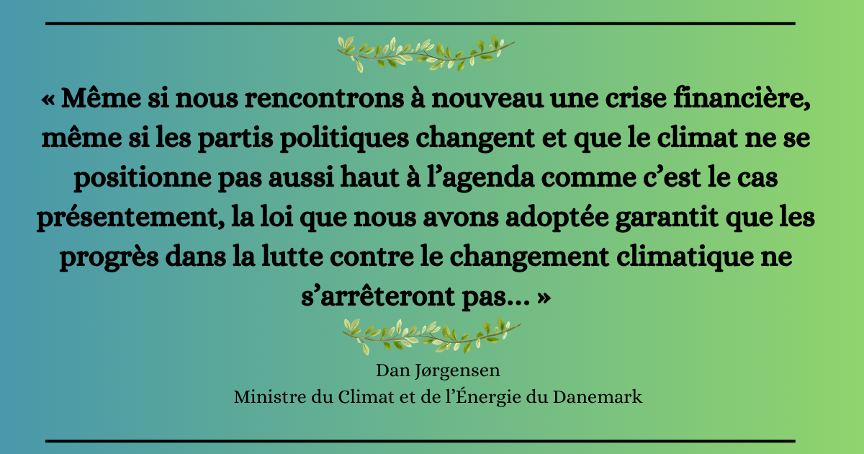
  • In Denmark, in 2020, almost all parties—including conservative parties—worked together to pass one of the strongest climate laws in the world. “Even if we encounter another financial crisis, even if political parties change, and even if the climate does not remain as high on the agenda as it is currently, the law we have adopted ensures that progress in the fight against climate change will not come to a halt…” Dan Jørgensen, Minister for Climate and Energy of Denmark
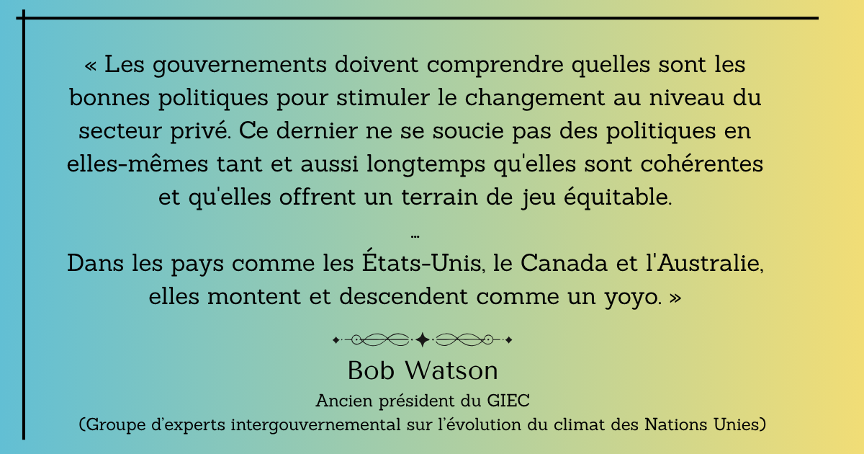
  • In 2022, countries with proportional representation systems saw higher levels of overall investment in climate policy. “Governments need to understand which policies are effective at driving change within the private sector. The private sector doesn’t care about the specific policies themselves, provided they are consistent and offer a level playing field. … In countries like the United States, Canada, and Australia, these policies go up and down like a yo-yo.” — Bob Watson, former chair of the IPCC
Why does proportional representation offer better protection for the planet?

Our current system (Majoritarian) The system of tomorrow (Proportional)
Short-term vision: Governments act with an eye toward upcoming elections. Long-term perspective: Environmental policies are long-term in nature.
Partisan sabotage: A new government can, by decree, overturn the progress made by its predecessor. Lasting laws: Decisions are reached by consensus and endure beyond changes in political leadership.
Locked-in ideas: Ecological proposals are often dismissed by the party in power. Diversity of voices: Scientific and ecological perspectives are at the heart of the decisions.
I vote FOR

equal representation of women in the National Assembly

Despite political pressure on parties, the current electoral system fails to ensure gender equality in politics. While parties may present a facade of parity among their candidates, the reality on the ground is frequently criticized: women are too often relegated to constituencies deemed “losing” or unwinnable. Consequently, their election is rarely guaranteed.

A proportional electoral system makes it possible to ensure that, across all constituencies, between 40% and 60% of the candidates put forward by each party are women.

  • The regional list system makes it easier to regulate a degree of gender parity, ensuring that female candidacies more consistently translate into female representatives. Bill 199  stipulates that any list of candidates proposed by a political party for a given region must alternate between female and male candidates, and that at least 50% of the lists submitted by the party to the Chief Electoral Officer of Quebec (DGEQ) must begin with a female candidate.
  • Furthermore, for each party, the candidacies put forward across all 80 local constituencies must be reserved for female candidates in a proportion ranging from 40% to 60%.

Two visions of the role of women in politics:

The current (majoritarian) system The system of tomorrow (Mixed-Member Proportional)
Women are often sacrificed in unwinnable constituencies. Gender parity is guaranteed by law through the mechanism of regional lists.
An unstable female representation, subject to the goodwill of the political parties. A legal requirement to have between 40% and 60% female candidates throughout Quebec.
A National Assembly that struggles to reflect half the population. A fair, modern, and gender-balanced “Blue Salon,” where every gender has its place.
I vote FOR

a reform more necessary than ever

50 years of broken promises: electoral reform can no longer wait

Every political party in Quebec has, at one point or another in its history, promised to reform our electoral system. Yet, once comfortably ensconced in power thanks to this unfair system, successive governments have consistently gone back on their word.

It is not a lack of ideas; it is a lack of political courage. The state has remained deaf to the appeals of a people who have shown exemplary patience. We have a long history of missed opportunities.

  • Every political party on the Quebec scene has, at one time or another, taken the position that the electoral system should be reformed. This includes Jean Charest’s Liberal Party; the Parti Québécois—both today and under leaders like Bernard Landry or René Lévesque; the ADQ and the CAQ (prior to the end of 2021); the Conservative Party (since 2023); and Québec solidaire (since its founding). In each instance, the models discussed or proposed were various versions of a mixed-member proportional electoral system with regional compensation. Yet, once in power, these parties invariably abandoned their plans—for reasons that had nothing to do with the health of our political democracy.
  • In 1979, the Quebec government, under the leadership of René Lévesque and minister Robert Burns, initiated discussions that resulted in a report proposing changes to the electoral system—though these proposed changes were never successfully implemented.
  • Then, in 2002, Minister Jean-Pierre Charbonneau invited the public “to take their place” and convened a series of *États généraux* (broad public consultations). The vast majority of Quebecers supported changes to the electoral system, yet the political parties could not reach an agreement. In 2004, Minister Dupuis introduced a bill—but it failed. In 2006, backed by a promise from his Premier, Minister Benoît Pelletier proposed further changes following another public consultation—again, without success. But, believe it or not, the government has remained deaf to the people’s calls. Yes, the people of Quebec are certainly patient!
  • Given this demand—which has been voiced repeatedly over the past three years—some may well raise an eyebrow, especially in light of the major crisis brought about by President Donald Trump. Yet, if one takes the trouble to reflect on the consequences of the assault by the leader of the world’s current preeminent power on the future of democracies—including American democracy itself—it becomes clear that, now more than ever, political institutions must be worthy of trust. They must serve as a foundation for building bridges and fostering broad coalitions, essential for confronting the challenges of today and tomorrow.

The political assessment is clear:

The current status quo Modern Democracy (Law 199)
Partisan calculations to maintain an artificial hold on power. Upholding the promises made to citizens for 50 years.
Weakened institutions that fuel cynicism. Strong, trustworthy, and inclusive institutions.
An electoral map layout that divides regions. A regional compensation mechanism that unites and protects the territory.

The Coalition for Electoral Reform

On the occasion of the International Day of Democracy (September 15, 2026) — With one year to go before the next general election, twenty-five (25) major civil society organizations are joining forces with the Mouvement Démocratie Nouvelle to demand that electoral system reform be made a key issue in the election campaign, which has concluded on October 5, 2026. On June 1, 2026—coinciding with the launch of the MDN’s “I Vote FOR” (*Je vote POUR*) campaign—this coalition for electoral reform published an open letter calling on all political parties to disclose the solutions they intend to propose to the people of Quebec to put an end to the democratic deficits caused by the first-past-the-post electoral system.

The CSN votes IN FAVOR OF a reform of the electoral system. here

The FTQ is lending its voice to the “JE VOTE POUR” (I VOTE FOR) campaign, organized by the Mouvement démocratie nouvelle (MDN). here

The CSQ (Centrale des syndicats du Québec) is calling on political parties to state their positions regarding a reform of the electoral system. here

Read the statementOpen letter from the union

Together, let’s change the rules of the game:

Download, share, display

Click on the image to enlarge it and on the button to download them

Wallpapers

Email signature

Le MDN est voué à modifier notre mode scrutin hérité des Britanniques pour en faire un mode de scrutin réellement représentatif de la volonté des électeurs·trices. Le MDN a pris naissance en 1999.

The NDM is committed to changing our electoral system—inherited from the British—into one that truly reflects the will of the voters. The MDN was founded in 1999.

Nous joindre / Contact us

Adresse / Address :